
Squonk Viz Data Centre

Tim Dudgeon 2026-11-03
POST
This post describes an important enhancement to Squonk Viz that greatly improves scalability and performance. Data is now stored in a PostgreSQL database running the RDKit cartridge which allows datasets of millions of structures to be used, and provides advanced chemistry functionality like structure search and molecular property predictions.
Early versions of Squonk Viz parsed the data files (typically SD-files or CSV files with SMILES) and that happened in the browser. This performed reasonably well, but clearly had limitations in scale and was not very efficient. Instead of this we now have what we refer to as the “Data Centre” which is essentially a PostgreSQL database with each dataset being a table. Each Squonk project gets its own database schema keeping the data from different projects isolated.
This approach has a number of important benefits
- file loading becomes a one-time import operation. Once done the data is instantly accessible and there is no need to re-parse the data
- you can import local files and files from URLs as well as files from your Squonk project
- operations such as filters, joins and groupings are done by in the database (which is already highly optimised for such operations) rather than a brute force row-by-row analysis in the browser
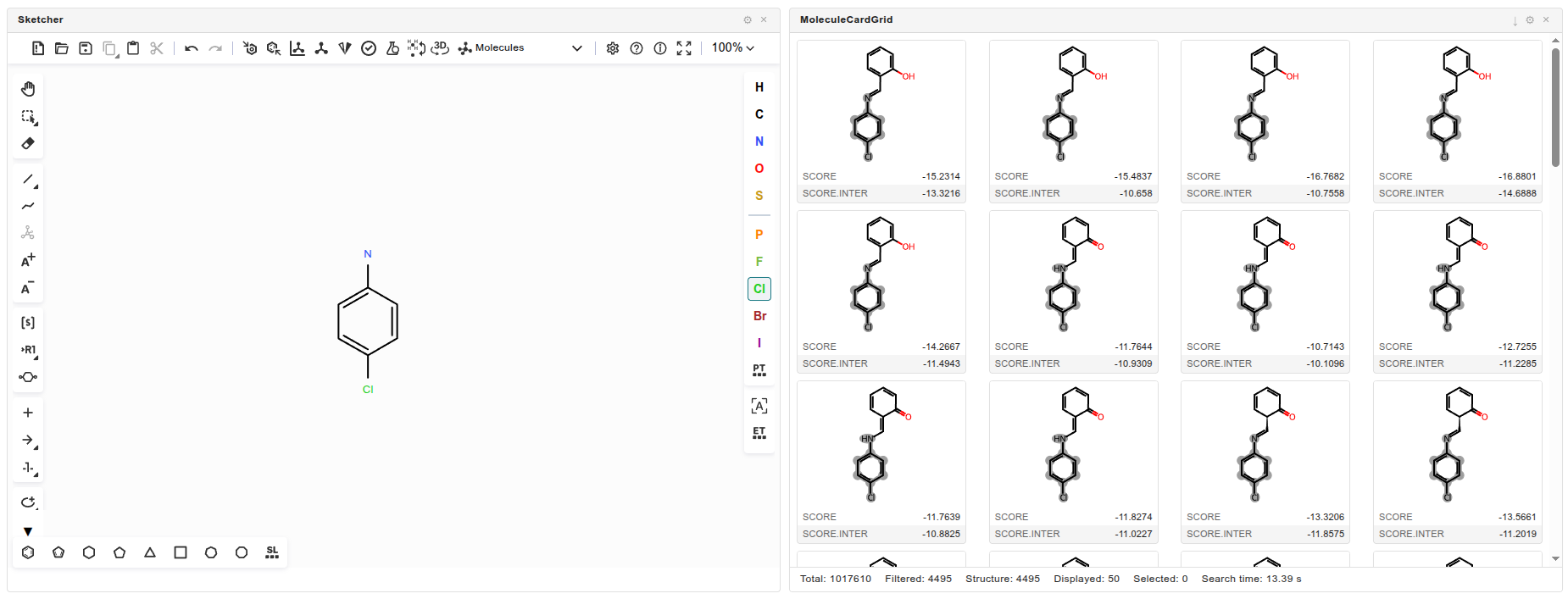
- structures can be indexed with the RDKit cartridge providing rapid substructure and similarity search, rather than brute force row-by-row analysis in the browser
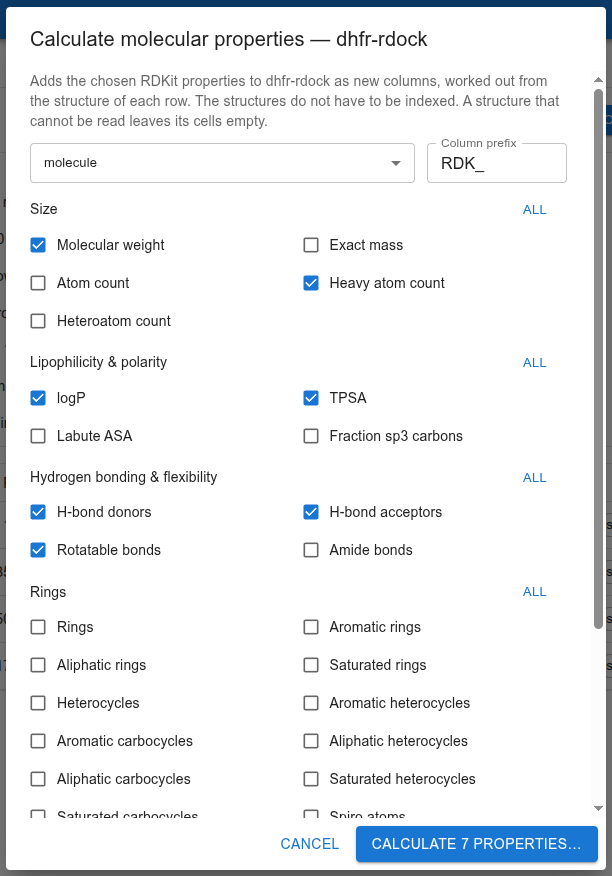
- molecular properties can be calculated/predicted and added to the dataset using the RDKit cartridge
- indexes can be added to speed up operations like queries
Indexing the structures is optional. It’s only needed if you want to use structure search.
Here is an example of using structure search:
And here is an example of calculating molecular properties:
Here are some sample timings for a number of important operations with various sizes of data. Import and Index are one-time operations - once done they don’t need repeating. The search times are for substructure search and are an average of 3 searches, not including the first search which takes a little longer as the index is being loaded into memory.
| num molecules | import | index | search |
|---|---|---|---|
| 35,090 | 34s | 1m 53s | 0.22s |
| 350,900 | 5m 31s | 12m 24s | 1.65s |
| 1,017,610 | 10m 50s | 28m 09s | 14.1s |
The search timing for the biggest set is not actually optimal as the hardware used for the database is quite modest. More memory (especially shared_buffers), faster I/O and more CPU cores would make it a bit faster, but even as it is it’s pretty respectable.
You can access Squonk here.
latest posts
by year
2026
2024
2023
2021
2020
Fragment Network REST API Cookie-cutting Ansible Kubernetes Projects Deploying container images from a private GitLab registry Fragment network basics Fragment network intro Redirecting to www with an nginx ingress Installing Kubernetes with Pharos Virtual screening for SARS-Cov-2 main protease inhibitors
2019
2018
by category
Blog
Containers
Software design
Automation
AWS ParallelCluster v3 Custom Images Migrating to AWS ParallelCluster v3 Kubernetes object linting with popeye GitHub Actions for container images Cookie-cutting Ansible Kubernetes Projects Installing Kubernetes with Pharos Building machine images with Packer Python and the Jenkins API Applying the build process to the deployment
IaC
Docking
Fragment network
Kubernetes
Kubernetes PreStop Lifecycle Hooks A kubernetes volume replicator Fixing a broken etcd cluster Kubernetes object linting with popeye Cookie-cutting Ansible Kubernetes Projects Deploying container images from a private GitLab registry Redirecting to www with an nginx ingress Installing Kubernetes with Pharos
Web
Ansible
Python
Squonk